본문
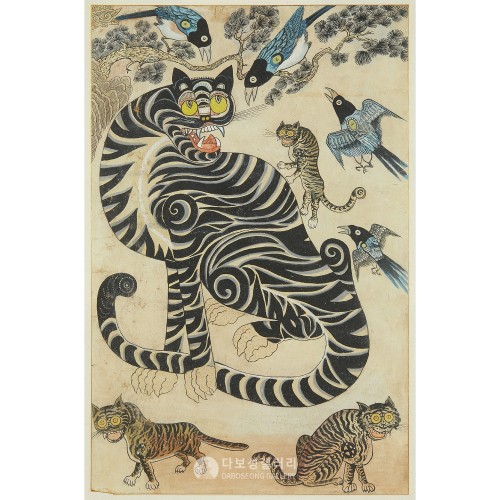
어미와 새끼 호랑이들, 소나무 위 까치가 그려진 그림입니다. 호랑이와 까치가 그려진 호작도(虎鵲圖)이면서 새끼 호랑이가 등장하여 유호도(乳虎圖)이기도 합니다. 호랑이와 까치는 벽사와 길상의 상징이며, 어미와 새끼 호랑이는 다산과 번영을 기원하는 의미입니다. 보호와 번영, 경사의 상징이 한 화면에 담겨 있습니다.
호랑이는 액운을 물리치고 권위와 수호를 상징하는 존재이지만, 이 그림에서는 과장된 표정과 굽이친 몸으로 표현되어 해학적인 인상을 줍니다. 호랑이 주변의 까치는 길한 소식을 전하는 길조로 경사와 축복의 분위기를 더하고, 소나무와 바위는 장수와 절개를 상징하여 길상적 성격을 한층 더해줍니다.
화면 상단에 소나무와 까치 네 마리, 중앙에 어미 호랑이와 등에 오른 새끼 호랑이, 하단에 나머지 새끼 호랑이 두 마리의 배치는 조선 후기 호작도의 도안화된 특징으로 볼 수 있습니다. 이러한 도상의 구성은 19세기 화가 신재현(申在鉉)이 그린 호작도에서 나타납니다. 유사한 구성으로 보아 이 유물은 신재현의 작품을 범본으로 제작되었을 가능성이 있습니다.
━━━━━
画作描绘母虎与幼虎,以及松树上的喜鹊。它既是描绘虎与喜鹊的虎鹊图,又因为出现了幼虎,也可称为乳虎图。虎与喜鹊象征辟邪与吉祥,母虎与幼虎则寄托了对多子多福与繁荣昌盛的祈愿。同一画面之中呈现守护、繁荣与喜庆。
老虎象征驱除厄运、权威与守护,但在这幅作品中,老虎表情夸张、躯体蜿蜒,营造出一种诙谐幽默的视觉效果。老虎周边的喜鹊作为传递吉祥消息的瑞鸟,为画面增添了喜庆与祝福的氛围;松树与岩石则象征长寿与坚贞,增添作品的吉祥寓意。
画面上方描绘松树与四只喜鹊,中部是母虎及骑在其背上的幼虎,下方则是另外两只幼虎。这种布局可视为朝鲜后期虎鹊图程式化构图的特征。类似的图像构成出现在19世纪画家申在铉所绘的虎鹊图中。基于构图上的相似性,这件作品很可能是以申在铉的作品为范本制作而成。
━━━━━
This painting depicts a mother tiger with her cubs and magpies perched on a pine tree. It is a Hojakdo (Painting of Tiger and Magpie), featuring a tiger and magpies, but the inclusion of cubs also classifies it as a Yuhodo (Painting of Nursing Tiger). The tiger and magpie are symbols of warding off evil spirits and auspiciousness, while the mother tiger and her cubs signify wishes for fertility and prosperity. Thus, symbols of protection, prosperity, and celebration are harmoniously captured within a single scene.
Although the tiger is traditionally a being that expels misfortune and symbolizes authority and guardianship, in this painting, it is rendered with an exaggerated expression and a contorted body, creating a humorous impression. The magpies surrounding the tiger are auspicious birds believed to bring good news, enhancing the atmosphere of celebration and blessing. Additionally, the pine tree and rock symbolize longevity and integrity, further engaging the auspicious nature of the work.
The composition—four magpies on a pine tree at the top, the mother tiger with a cub on her back in the center, and two additional cubs at the bottom—is a stylized characteristic of late Joseon Dynasty Hojakdo. This specific iconographic arrangement appears in Hojakdo painted by the 19th-century artist Sin Jae-hyeon. Given the similarity in composition, it is possible that this artifact was produced using Sin Jae-hyeon's work as a model.