작품 정보
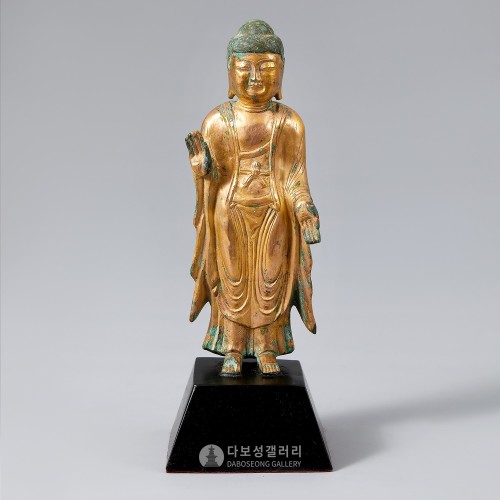
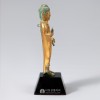
통일신라 후기에 제작된 금동여래입상입니다. 정수리에는 육계(肉髻)가 솟아 있으며, 얼굴은 둥글고 살이 오른 모습입니다. 목에는 삼도(三道)가 있습니다. 눈은 가늘게 감고 입은 오므려 은은한 미소를 띠고 있습니다. 육계는 깨달음을 상징하고, 삼도는 혹도(惑道)·업도(業道)·고도(苦道)를 의미하며, 자비로운 표정은 부처의 신성을 나타냅니다.
법의는 양어깨를 모두 덮는 통견식(通肩式)으로, 옷자락이 양팔을 따라 길게 내려와 몸 전체를 감싸고 있습니다. 가슴에는 내의와 띠매듭 표현이 확인됩니다. U자형 의문(衣紋)이 반복되며, 단순화된 형태로 일정한 간격을 이루고 있습니다.
오른손은 들어올려 손바닥을 밖으로 향한 시무외인(施無畏印)을, 왼손은 아래로 내려 손바닥을 앞으로 향한 여원인(與願印)을 취하고 있습니다. 시무외인과 여원인은 중생의 두려움을 덜고 소원을 이루어 주는 의미를 담고 있습니다.
신체 비례는 둔중하며, 옷주름은 반복·형식화되고, 이목구비는 평면화된 경향을 보이는데, 이는 통일신라 후기 불상에서 나타나는 특징입니다.
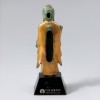
불상의 뒷면에는 머리와 몸체의 아래에 구멍이 뚫려 있으며, 광배(光背)나 두광(頭光)을 결합하기 위한 구조로 추정됩니다. 불상은 내부를 비운 중공식으로 주조되었습니다. 표면에는 도금이 잘 보존되어 있으며, 일부 녹청이 확인되나 전반적인 보존 상태는 우수한 편입니다. 도금은 시각적 장엄성과 종교적 권위를 드러냅니다.
━━━━━
此为统一新罗后期制作的鎏金铜如来立佛像。其头顶隆起肉髻,面容圆润丰腴。颈部饰三道纹,双眼微闭,双唇微抿,带有含蓄而柔和的微笑。肉髻象征觉悟,“三道”是指惑道、业道与苦道。慈悲的表情则体现了佛的神性。
袈裟采用通肩式,覆盖双肩,衣摆沿双臂自然下垂,包裹全身。胸前可见内衣与系带结的表现。衣纹呈反复出现的U字形,褶皱形式趋于简化,并以均匀的间隔排列。
右手上举,掌心向外,作施无畏印;左手下垂,掌心向前,作与愿印。施无畏印与与愿印寓意消除众生的恐惧,并实现其愿望。
其身体比例厚重,衣纹呈重复与程式化特征,五官趋于平面化,这些均符合统一新罗后期佛像的典型特征。
佛像背面在头部与身体下方开有较大的孔洞,推测为用于连接光背或头光的结构。佛像采用中空铸造工艺,表面鎏金保存良好,虽可见部分铜锈,但整体保存状况较为优良。镀金体现了视觉上的庄严性与宗教权威。
━━━━━
This is a A Gilt-Bronze Standing Buddha produced in the late Unified Silla period. The top of the head features a raised ushnisha, and the face is rounded with full cheeks. Three neck lines are visible. The eyes are gently closed, and the lips are slightly pursed, forming a subtle smile. The ushnisha symbolizes enlightenment, the three neck lines represent illusion, karma, and suffering, and the serene expression conveys the sacred nature of the Buddha.
The robe is worn in the tonggyeon style, covering both shoulders, with the drapery falling along the arms and enveloping the entire body. The inner garment and a knotted sash are visible on the chest. U-shaped drapery folds are repeated in a simplified and evenly spaced manner.
The right hand is raised with the palm facing outward in the abhaya mudra, while the left hand is lowered with the palm facing forward in the varada mudra. These gestures signify the removal of fear and the granting of wishes.
The body proportions are heavy, the drapery folds are repetitive and formalized, and the facial features appear flattened—characteristics associated with late Unified Silla Buddhist sculpture.
On the back of the figure, holes are present below the head and body, likely used to attach a halo or head halo. The figure was cast using a hollow-core technique. The gilding on the surface is well preserved, and although some green corrosion is visible, the overall condition is excellent. The gilding enhances both the visual splendor and the religious authority of the figure.
CONDITION
NOTICE
상담/문의 : 02- 730-5601 / 02- 730-7566