본문
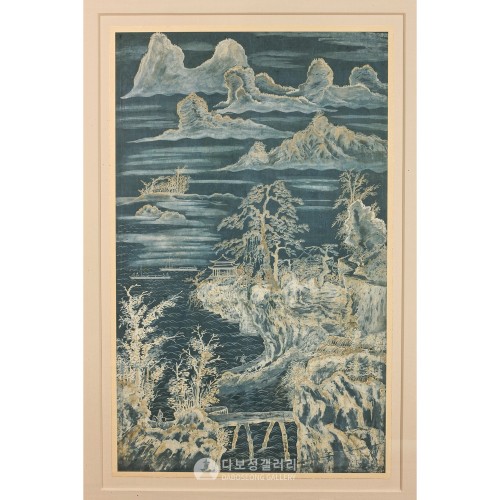
16세기 말에서 17세기 초 무렵 제작된 허주 이징(虛舟 李澄, 1581~?)의 니금산수도(泥金山水圖)입니다. 이징은 산수, 인물, 영모 등 분야를 가리지 않고 두루 능하였고, 도화서 화원으로 활동하며 궁중 회화 제작에 참여하였습니다. 문인 허균(許筠, 1569~1618)이 ‘본국제일수(本國第一手)’라 평할 만큼 당대에 높은 평가를 받았습니다.
금분을 아교에 개어 만든 금니(金泥)를 사용하였습니다. 바탕은 쪽물을 들인 감지(紺紙)입니다. 푸른 바탕 위에 금니가 대비를 이룹니다. 금은 신분에 따라 사용이 제한되었으며, 니금 회화는 왕실과 사대부층을 중심으로 제작되었습니다.
화면 하단에는 말을 탄 인물과 나무 다리가 보입니다. 강가에는 물고기가 걸린 낚싯대를 어깨에 멘 인물이 있습니다. 화면 중앙에는 소나무와 암반 사이에 누각 두 채가 있고, 강 위로 배 두 척이 떠 있습니다. 그 뒤로는 안개가 깔린 하늘과 산이 보입니다.
경물은 화면 하단 우측에 치우쳐 편파구도를 형성하고, 공간은 근(近)·중(中)·원경(遠景)으로 나타내었습니다. 산세는 운두준법(雲頭皴法)으로 구름이 피어오르듯 표현하였고, 수목은 세형침수(細形針樹)의 가는 필선으로 묘사되었습니다. 이러한 특징은 안견파(安堅派) 화풍의 전통을 반영합니다.
시선은 다리에서 배, 누각, 소나무를 거쳐 산세와 구름으로 교차하며 이동하게 됩니다. 이러한 화면 구성은 17세기 이징의 산수도에서 두드러지는 특징입니다. 치밀한 필선과 굴곡 표현, 농담 처리에서 숙련된 기량이 드러납니다. 조선시대 니금산수도 가운데에서도 완성도가 높은 사례입니다.
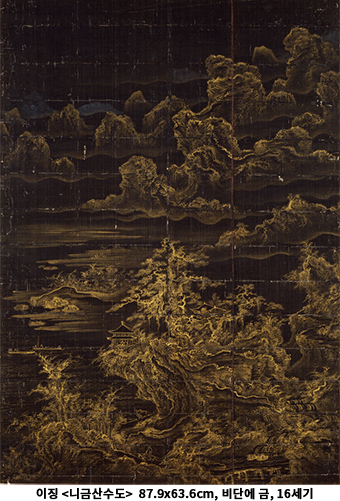
이 유물은 충청남도 논산시 노성면에 위치한 명재 윤증(明齋 尹拯, 1629~1714)의 고택, 이른바 노성 윤대감댁에 소장되었던 것으로 추정됩니다. 이징의 것으로 전해지는 니금 회화는 국립중앙박물관, 간송미술관, 북한 조선미술박물관 등에도 소장되어 있습니다.
━━━━━
此为16世纪末至17世纪初所作朝鲜时期画家虚舟李澄的《泥金山水图》。李澄兼擅山水、人物、翎毛等诸科,曾任图画署画员,参与宫廷绘画创作。文人许筠(1569~1618年)曾赞其为“本国第一手”,可见其在当时画坛享有极高声誉。
作品以金粉调胶制成的金泥作画,绘于经靛染成的绀纸之上。深蓝底色与金泥线描形成鲜明对比。朝鲜时代金材的使用受到身份等级限制,泥金绘画多为王室及士大夫阶层所制作与收藏。
画面下方可见骑马人物与木桥;江畔有肩扛钓竿、竿上悬鱼之人。画面中央松树与岩石之间立有两座楼阁,江面上泊有两艘小舟,其后远山隐现于烟霭之中。
构图上景物偏于画面右下方,形成偏置式布局;空间处理呈现近景、中景、远景的层次递进。山石以“云头皴”表现,如云气翻涌;树木以细劲针状笔法勾勒,体现安坚派山水画风的传统特征。
观者视线自桥而起,经小舟、楼阁与松树,上达山势与云气,形成交错流动的视觉路径。此类画面构成方式为17世纪李澄山水画的重要特色。作品笔线精细,山石转折与墨色浓淡变化处理娴熟,展现出高度成熟的艺术技巧,堪称朝鲜时期泥金山水画中完成度极高的代表之作。
据推测,此作曾藏于忠清南道论山市鲁城面之名斋尹拯(1629~1714年)旧宅,即“鲁城尹大监宅”。现今传为李澄所作的泥金绘画,亦见藏于韩国国立中央博物馆、涧松美术馆及北朝鲜美术博物馆等机构。
━━━━━
This is a landscape painting in gold paint by Heoju Yi Jing (1581–?), produced around the late 16th to early 17th century. Yi Jing was proficient in various genres, including landscapes, figures, and birds and animals, and participated in the production of court paintings as a court painter of the Royal Bureau of Painting. He was highly esteemed in his time, to the extent that the literati Heo Gyun (1569–1618) praised him as the "best hand in the country."
This work uses geumni, gold paint made by mixing gold powder with glue. The background is gamji (indigo-dyed paper), creating a striking contrast between the blue background and the gold paint. As the use of gold was restricted according to social status, gold-painted paintings were primarily produced for the royal court and the literati class.
At the bottom of the scene, a figure on horseback and a wooden bridge are visible. By the riverside, there is a figure carrying a fishing rod with a fish on his shoulder. In the center, two pavilions sit between pine trees and rocks, with two boats floating on the river. Behind them, a misty sky and mountains appear.
The composition is weighted toward the lower right, creating a one-sided balance, and the space is divided into foreground, middle ground, and background. The mountains are depicted using the (cloud-head texture) method, resembling rising clouds, while the trees are rendered with fine, needle-like brushstrokes. These features reflect the tradition of the An Gyeon school style.
The viewer's gaze moves from the bridge to the boats, pavilions, and pine trees, crossing over to the mountains and clouds. This composition is a distinctive characteristic of Yi Jing’s landscapes from the 17th century. His skilled craftsmanship is evident in the precise brushwork, the expression of contours, and the handling of shading. This work is considered a highly accomplished example among the gold-painted landscapes of the Joseon Dynasty.
This artifact is presumed to have been kept at the historic house of Myeongjae Yun Jeung (1629–1714), known as the Noseong Yun Daegam House, in Noseong-myeon, Nonsan, Chungcheongnam-do. Other gold-painted works attributed to Yi Jing are held in collections such as the National Museum of Korea, the Kansong Art Museum, and the Korean Art Museum in North Korea.