
본문
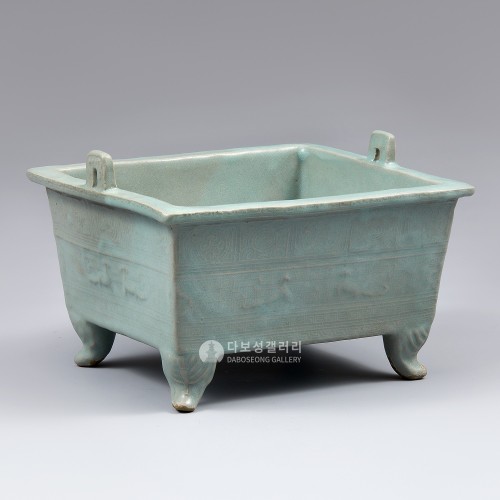
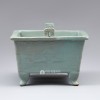
중국 고대 청동 방정(方鼎)의 기형을 모방한 고려시대 청자 향로입니다. 고려시대에는 예제(禮制)를 정비하는 과정에서 송나라의 제도와 문화를 수용하였으며, 고대 청동기 형식을 도자기에 반영하는 경향도 함께 받아들였습니다. 이 향로는 그 흐름을 보여주는 사례로, 송과 고려의 문화적 교류를 반영합니다.
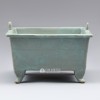
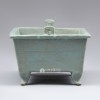
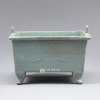
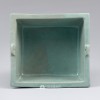
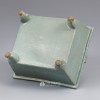
방형 몸체에 사각형 귀가 양쪽에 부착되어 있습니다. 구연은 평평한 전을 이루고, 바닥면에는 수족형 다리 네 개가 붙어 있어 동물의 발을 연상시킵니다.
외면에는 도철문(饕餮紋)을 중심으로 동심원문(同心圓紋), 회오리형 추상문, 뇌문(雷紋) 등 다양한 문양이 시문되어 있습니다. 문양은 얕게 눌러 찍어낸 양인각(陽印刻) 기법으로 표현되었으며, 기면을 따라 반복됩니다. 전면에는 담청색 유약이 고르게 시유되어 있습니다. 접지면은 유약을 닦아내 태토가 드러난 상태입니다.
향로는 향을 피워 의례에 사용된 유물로, 불교 의식이나 상류 계층의 공간에서 사용된 것으로 추정됩니다. 도철문과 방정형 기형의 결합은 권위와 의례성을 반영하는 조형 요소로 확인됩니다.
강진 사당리 가마터에서는 유사한 문양이 시문된 파편이 출토된 바 있으며, 국립중앙박물관에도 형태와 문양이 유사한 향로(등록번호 덕수3346)가 소장되어 있습니다. 또한 삼성미술관 리움에도 유사한 계열의 향로가 소장되어 있으며, 보물로 지정된 사례가 확인됩니다.
━━━━━
此青瓷香炉制作于高丽时期,形制模仿中国古代青铜方鼎器形。高丽时期在整备礼制的过程中,吸收了宋朝的制度与文化,同时也接受了将古代青铜器形式反映于陶瓷中的倾向。该香炉正是体现这一发展脉络的实例,反映了宋与高丽之间的文化交流。
器身呈方形,两侧附有方形耳。口沿形成平整的折缘,下承四兽足。
器物外表以饕餮纹为中心,并饰有同心圆纹、旋涡状抽象纹、雷纹等多种纹样。纹饰采用浅压印出的阳印刻技法,并沿器面反复排列。整体施以均匀的淡青色釉,接地部分刮去釉层,露出胎土。
香炉为焚香所用的器物,推测用于佛教仪式或上级阶层。饕餮纹与方鼎形制的结合,被认为是体现权威与礼制性的造型要素。
在江津沙堂里窑址曾出土带有类似纹样的陶片,国立中央博物馆亦收藏有形制与纹样相似的香炉(登记编号:德寿3346)。此外,三星立文美术馆也收藏有同一系列的香炉,并有被指定为国家宝物的实例。
━━━━━
This is a Goryeo celadon incense burner modeled after the form of an ancient Chinese bronze square ding. During the Goryeo period, as ritual systems were being established, the culture and institutions of the Song dynasty were adopted, along with the tendency to reflect ancient bronze forms in ceramics. This incense burner represents that trend and reflects cultural exchange between Song China and Goryeo.
The body is square in shape, with rectangular handles attached on both sides. The rim is flat, and four animal-leg-shaped supports are attached to the base.
The exterior is decorated with a central taotie motif, along with concentric circle patterns, swirling abstract designs, and thunder patterns. The designs are rendered using a raised stamped technique, pressed shallowly into the surface and repeated across the body. A pale bluish glaze is evenly applied overall. The foot area is wiped free of glaze, exposing the clay body.
The incense burner was used for burning incense in ritual contexts and is considered to have been used in Buddhist ceremonies or in elite spaces. The combination of the taotie motif and the square ding form reflects elements associated with authority and ritual use.
Similar patterned shards have been excavated from the Sadang-ri kiln site in Gangjin, and a comparable incense burner with similar form and decoration is held in the collection of the National Museum of Korea (accession number Deoksu 3346). A related example is also housed in the Leeum, Samsung Museum of Art, where a similar type has been designated as a Treasure.