본문
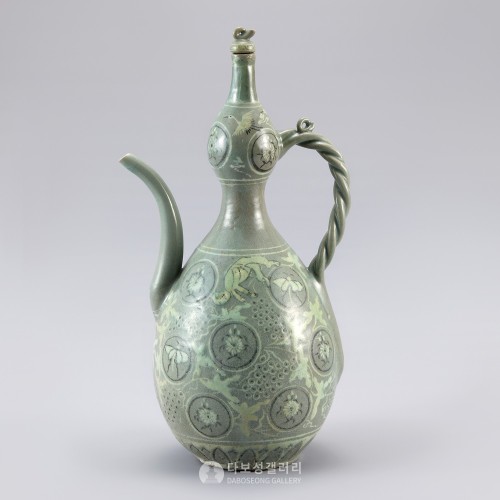
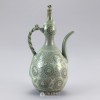
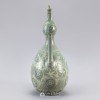
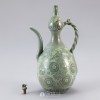
고려시대에 제작된 청자 주자입니다. 표주박을 닮은 표형(瓢形)의 형태입니다. 길게 뻗은 주구와 넝쿨을 상형한 손잡이는 별도로 제작하여 부착하였습니다. 뚜껑과 손잡이에는 작은 고리가 있습니다. 끈 등을 연결해 뚜껑의 유실을 방지하기 위한 용도로 보입니다. 굽은 낮고 깎음새가 비교적 단정합니다.
문양은 흑백 상감으로 시문하였습니다. 뚜껑 측면과 구연에는 뇌문(雷紋)을 둘렀고, 저부에는 연판문(蓮瓣紋)을 둘렀습니다. 동체 전면에는 이중 원권(圓圈)을 여러 곳에 배치하였으며, 그 안에 국화절지문(菊花折枝紋)과 나비문(蝶紋)을 교대로 시문하였습니다. 그 주변 바탕의 상단에는 운학문(雲鶴紋)을, 하단에는 포도동자문(葡萄童子紋)을 면상감 기법으로 시문하였습니다.
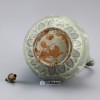
유약은 담녹색이 감도는 청자유를 전면에 시유하였습니다. 굽에는 유약이 닦여져 있고 태토 일부가 노출되어 있으며, 접지면에는 굵은 모래가 섞인 내화토 받침 흔적이 남아 있습니다.
제작 시기와 산지는 명확하지 않지만, 형태와 완성도를 고려할 때 표형 고려청자가 전성기를 이루던 12~13세기의 전라도 부안 유천리 계통의 것으로 추정됩니다.
상감청자는 제작 공정이 복잡하고 높은 숙련도를 필요로 하여 주로 왕실과 상류층에서 사용되었습니다. 의례, 연회, 차 문화 등 상류층 생활과 밀접한 유물입니다. 뚜껑이 함께 전해져 보존 상태가 양호하고 일부 손상 부위는 부분 수리가 이루어진 상태입니다.
━━━━━
此为高丽时期烧制之青瓷执壶。整体作瓢形,造型取自葫芦之姿。流口修长挺拔,柄部塑作缠枝形态,均为分件制作后粘接而成。盖与柄上均设小系,应为穿绳固定之用,以防盖失。圈足低矮,修足利落规整。
执壶以黑白象嵌工艺绘制纹饰。盖侧与口沿环饰雷纹,近足部饰莲瓣纹。器身通体以多组双重圆圈为框,其内交替饰折枝菊花纹与蝴蝶纹。圆圈之外,上部以面象嵌技法饰云鹤纹,下部饰葡萄童子纹。
通体施青釉,釉色淡雅青绿。圈足露胎,足端可见修刮痕迹,接地面残留含粗砂之耐火土垫烧痕。
具体窑址与烧造年代虽未有明确记载,依据造型风格与制作水准来看,应属高丽青瓷瓢形执壶鼎盛时期之作,约为12至13世纪,全罗道扶安郡柳川里窑系。
高丽象嵌青瓷制作工序繁复,工艺要求极高,多为王室及上级阶层所用,与礼仪、宴飨及茶文化密切相关。此器盖体俱全,保存状况良好,局部损伤处曾有修复。
━━━━━
This is a celadon ewer (jug) produced during the Goryeo Dynasty. It is shaped in the form of a gourd (pyo-hyeong). The long, extended spout and the handle modeled in the shape of a vine were crafted separately and then attached to the body. Small loops are affixed to both the lid and the handle, likely intended for threading a cord to prevent the lid from being lost. The foot is low and neatly trimmed.
The decoration is executed using black-and-white inlay (sanggam). A thunder pattern (raemun) encircles the side of the lid and the rim, while lotus petal motifs (yeonpanmun) are arranged around the lower body. On the main body, multiple double circles are placed across the surface; within them, chrysanthemum scroll motifs (gukhwa jeoljimun) and butterfly motifs alternate. The surrounding ground is further embellished with cloud-and-crane motifs in the upper section and grape-and-boy motifs in the lower section, rendered in the surface inlay technique (myeonsanggam).
The entire surface is covered with a celadon glaze with a pale green tone. The glaze has been wiped from the foot, exposing portions of the clay body. Traces of a refractory clay support mixed with coarse sand remain on the contact surface.
Although the exact production date and kiln site are not definitively known, based on its form and level of craftsmanship, it is presumed to date to the 12th–13th century, when gourd-shaped Goryeo celadon flourished, and is attributed to the Yucheon-ri kiln system in Buan, Jeolla Province.
Inlaid celadon required a complex production process and a high degree of skill, and was therefore primarily used by the royal court and the elite class. Such wares were closely associated with upper-class life, including rituals, banquets, and tea culture. The lid survives with the vessel, and the overall state of preservation is good, with some areas having undergone partial restoration.