본문
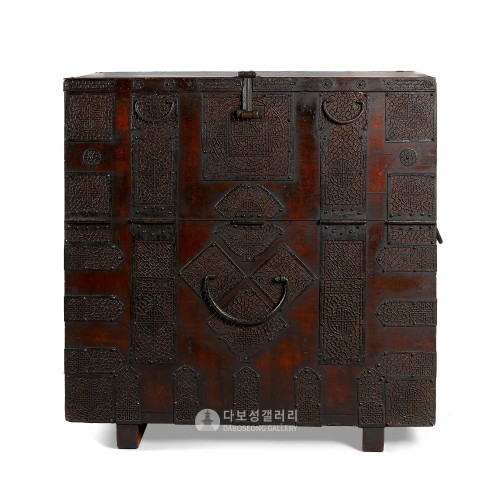
책이나 두루마리, 옷, 제기 등을 보관했던 강화 숭숭이 반닫이입니다. 앞판의 윗부분만 앞으로 젖혀 여닫는 구조이며, 내부에는 별도의 칸막이를 두지 않은 무형(無形) 구조로 제작되었습니다. 앞널·측널·뒷널은 주먹장사개로 짜였으며, 그 외 접합부에는 못을 더해 보강하였습니다. 전면과 모서리에는 철제 장석을 촘촘히 대어 결속을 강화하였습니다. 다리는 방형의 족대형으로, 통풍을 돕고 습기를 방지할 수 있습니다.
전면에는 투각 장석이 가득 배치되어 있습니다. 무쇠판에 작은 구멍을 반복적으로 뚫어 문양을 형성하였습니다. 만(卍)자무늬, 기하학무늬, 꽃무늬 등이 함께 보입니다. 앞널 중앙에는 마름모꼴 앞바탕 위에 대형 활형 들쇠가 달려 있으며, 문짝 상단과 측면에도 같은 형식의 소형 들쇠가 부착되어 손잡이 기능을 합니다.
목재는 결이 곱고 수축과 팽창이 크지 않은 피나무 또는 호두나무가 사용되었습니다. 뒤틀림과 갈라짐이 적고, 표면이 매끈하게 마감되어 장지 및 칠 마감에 적합합니다. 바탕은 흑색으로 마감하여 투각 장석의 효과를 강조하였습니다.
조선시대 궁궐이 서울과 경기 지역에 있었던 만큼 경기 강화에서 제작된 이 반닫이는 왕실 및 사대부 계층에서 사용된 목가구로 추정됩니다. 또한 평안도 지역 장인들의 제작 기법이 전해지면서, 두 지역 양식이 함께 반영된 형태로 추정됩니다.
━━━━━
此为用于保存书籍、卷轴、衣物及祭器等物品的江华产半开式柜。其结构为仅将前板上部向前掀起进行开合,内部未设置任何隔板,为无隔层结构。前板、侧板与后板采用燕尾榫结构拼接,其余接合部位辅以铁钉加固。正面与边角密布铁制装饰件,以增强整体的结实度。底部为方形台座式足部结构,有助于通风并防止受潮。
正面布满镂空装饰。在铁板上反复打出细小孔洞以形成纹样,可见万字纹、几何纹及花卉纹等。前板中央在菱形底座上装有大型弓形提手,门板上端及侧面亦附有相同形式的小型提手,兼具把手功能。
木材选用纹理细腻、收缩与膨胀较小的椴木或胡桃木。其不易翘曲或开裂,表面光滑平整,适用于裱纸及上漆处理。整体底色施以黑色处理,以突出透雕金属装饰的视觉效果。
由于朝鲜时期宫殿位于首尔及京畿地区,此件在京畿道江华地区制作的木柜推测为王室及士大夫阶层所使用的木制家具。同时,随着平安道地区工匠制作技法的传入,其形制被认为融合了两地的工艺风格。
━━━━━
This is a ssungsungi chest from Ganghwa used to store books, scrolls, garments, and ritual vessels. It is constructed with a structure in which only the upper part of the front panel tilts forward to open and close, and the interior is made without separate partitions in an unsegmented form. The front, side, and back panels are joined with dovetail joints, and other joints are reinforced with nails. Iron fittings are densely applied to the front and corners to strengthen the structure. The legs are of a square jokdae-type, allowing ventilation and helping to prevent moisture.
The front is fully arranged with openwork metal fittings. The patterns are formed by repeatedly perforating small holes into an iron plate. Swastika motifs, geometric patterns, and floral designs are observed together. At the center of the front panel, a large bow-shaped handle is attached on a lozenge-shaped mount, and smaller handles of the same type are affixed to the upper and side parts of the panel, serving as grips.
The wood used is linden or walnut, which has fine grain and does not exhibit significant shrinkage or expansion. It is resistant to warping and cracking, and the surface is smoothly finished, making it suitable for papering and lacquer finishing. The base is finished in black to emphasize the effect of the openwork metal fittings.
As royal palaces during the Joseon dynasty were located in Seoul and the Gyeonggi region, this chest produced in Ganghwa is presumed to have been used by the royal court and the aristocratic class. It is also considered to reflect a combination of regional styles, as the techniques of craftsmen from the Pyeongan region were transmitted and incorporated.