본문
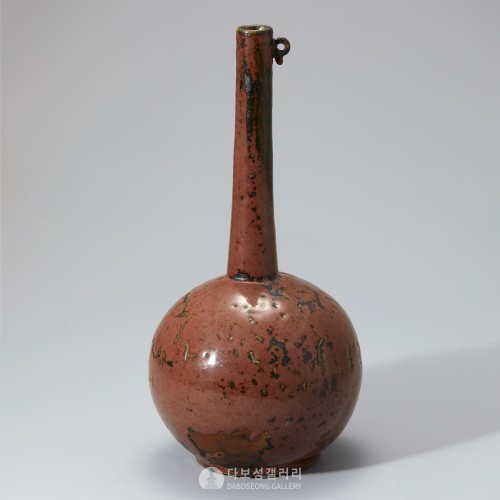
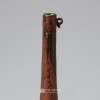
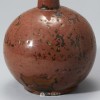
좁은 구연부와 긴 목, 구형 동체를 지닌 고려시대 장경병(長頸甁)입니다. 이러한 형태의 병은 마치 학의 머리를 닮았다고 하여 학수병(鶴首甁)이라 부르기도 합니다. 구연부 상단에는 작은 고리가 부착되어 있으며, 끈 등을 걸어 뚜껑의 유실을 방지하기 위한 연결고리로 보입니다.
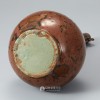
유물 전체에 청자 유약을 시유하여 초벌한 뒤, 산화동 안료를 바르고 다시 유약을 입혀 소성하였습니다. 소성 과정에서 요변 현상이 일어나 도자기 표면에는 자연스러운 요철과 색조의 변화가 나타납니다. 유약층의 표면 위로 은은한 광택이 드러나며 질감이 관찰됩니다. 굽 바닥과 내부에는 적색 안료가 시유되지 않아 푸른 청자 유약이 그대로 남아 있습니다. 편평한 굽 바닥에 내화토(耐火土)를 받쳐 구운 흔적이 확인됩니다.
진사채 청자는 제작 난이도가 높고, 붉은색이 상서로운 기운을 상징한다는 인식으로 인해 고려시대 황실이나 귀족층에 진상되던 고급 자기로 알려져 있습니다. 이 유물 역시 상류층에서 사용되었을 가능성이 큽니다. 또한, 유사한 형태의 고려시대 장경병이 일본 오사카 동양도자미술관에 소장되어 있어 귀중한 유물로 사료됩니다.
━━━━━
这是高丽时代的长颈瓶,小口、长颈、球腹。由于其整体造型酷似仙鹤的头部,此类器物亦被称为“鹤首瓶”。口沿上方附有一枚小型环钮,推测用于系绳,以防止瓶盖遗失。
器物通体施以青瓷釉,经过素烧后在局部绘施氧化铜颜料,再罩釉高温烧成。烧制过程中产生窑变效果,使器表呈现出自然的起伏肌理与丰富的色调变化。釉面泛出柔和而内敛的光泽,质感细腻。足底与器内未施红彩,保留了青瓷釉本色;足底可见垫烧所用耐火土的痕迹。
辰砂彩青瓷制作工艺复杂,且红色在高丽时代被视为吉祥与瑞兆之色,此类器物多作为贡品进献皇室或供贵族阶层使用。本件器物亦极有可能为上层社会所用。此外,日本大阪东洋陶瓷美术馆亦藏有形制相近的高丽长颈瓶,进一步印证了该器物的重要历史与艺术价值。
━━━━━
This is a long-necked vase from the Goryeo Dynasty, characterized by a narrow mouth, a long neck, and a globular body. Due to its resemblance to the head of a crane, this type of vase is also referred to as a Crane-Neck Vase. A small loop is attached to the upper part of the mouth, which appears to be a connecting ring intended to hold a string to prevent the loss of the lid.
The entire artifact was coated with celadon glaze and underwent an initial firing; subsequently, copper-oxide pigment was applied, followed by another layer of glaze and final firing. During the firing process, kiln transmutation occurred, resulting in natural irregularities and tonal variations on the porcelain surface. A subtle luster appears over the surface of the glaze layer, revealing its texture. The base and the interior were not coated with the red pigment, leaving the blue celadon glaze intact. Additionally, traces of fireclay supports used during firing are visible on the base.
Celadon with copper-red underglaze is known as a high-quality porcelain that was presented to the Goryeo royal court or aristocracy, due to the high difficulty of production and the perception that the red color symbolizes auspicious energy. It is highly likely that this artifact was also used by the upper class. Furthermore, a similar Goryeo-dynasty long-necked vase is housed in the Museum of Oriental Ceramics, Osaka, suggesting that this is a valuable artifact.