본문
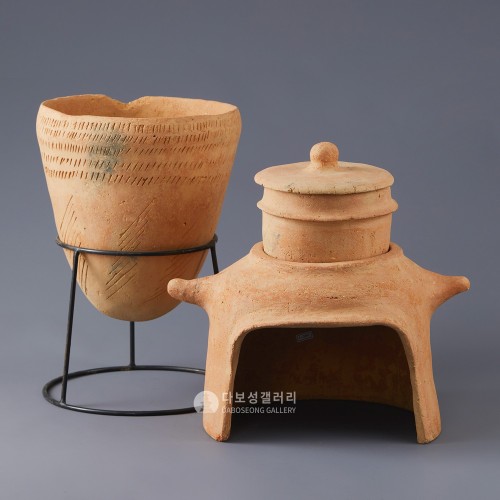
이 유물은 고운 황토를 빚어 만든 빗살무늬 토기(즐문토기)와, 당시의 생활상을 보여주는 아궁이 및 솥이 함께 구성된 작품입니다.
V자 모양의 뾰족한 바닥을 가진 토기는 그 형태적 특성상 땅에 살짝 파묻거나 고정하여 세워두기 좋게 만들어졌으며, 주로 수확한 곡식의 씨앗을 보관하거나 먹다 남은 음식을 저장하는 용도로 사용되었습니다. 표면에는 빗살무늬 특유의 기하학적인 선들이 새겨져 있어 당시 사람들의 미적 감각을 엿볼 수 있습니다.
특히 주목할 점은 함께 표현된 아궁이와 솥입니다. 이는 실제 당시 사람들이 일상에서 사용하던 부엌의 조리 시설을 그대로 본떠 토기로 재현한 것입니다. 이처럼 생활 도구를 축소하여 만든 모형은 주로 무덤에 함께 묻는 부장품(명기)으로 사용되었으며, 사후에도 현세와 같은 풍요로운 삶이 이어지기를 바라는 기원이 담겨 있습니다.
그릇 전반에 나타나는 붉은 색감은 재료인 황토의 성분 때문이기도 하지만, 소성(굽기) 과정에서 비롯된 특징이기도 합니다. 밀폐된 가마가 아닌 개방된 형태에서 산소를 공급하며 굽는 산화염 소성 방식을 사용했기 때문이며, 대체로 섭씨 600~700도 정도의 비교적 낮은 온도에서 구워져 토기 특유의 질감을 간직하고 있습니다.
━━━━━
这件文物是由细腻的黄土制成的栉文土器(又称刻纹土器)和展现当时生活面貌的灶釜(炉灶与锅)共同组成的。
呈V字形且底部尖锐的土器,其形态特征便于将其埋入土中或固定竖立,主要用于储存收获的谷物种子或吃剩的食物。器皿表面刻有栉文土器特有的几何纹样线条,由此可以窥见当时人们的审美意识。
特别值得注意的是与土器一同表现的灶与釜。这是将当时人们实际生活中使用的厨房烹饪设施原样模仿,用陶土再现而成的。像这样将生活用品缩小制作的模型,主要是作为随葬品(明器)与死者一同埋葬,蕴含着祈愿死后也能延续现世富足生活的心愿。
器皿整体呈现的红色色调,既源于材料黄土的成分,也是烧制过程中形成的特征。这是因为采用了在非密封的开放形态下供给氧气进行烧制的氧化焰烧制法。通常在摄氏600~700度左右的相对低温下烧制,保留了土器特有的质感。
━━━━━
This artifact is composed of comb-pattern pottery (Jeulmun pottery) crafted from fine red clay, accompanied by a stove and cauldron that reflect the lifestyle of the era.
The V-shaped pottery features a pointed bottom, a design intended to make it easy to embed in soft soil or prop up for stability. It was primarily used for storing harvested grain seeds or leftover food. The surface is engraved with the characteristic geometric lines of comb-pattern pottery, offering a glimpse into the aesthetic sense of the people of that time.
Particular attention should be drawn to the accompanying stove and cauldron. These are clay reproductions of the actual cooking facilities used in daily life. Such miniature models of everyday tools were often created as funerary objects (burial goods) to be buried with the deceased, embodying the wish for a prosperous life to continue in the afterlife.
The reddish hue that appears throughout the vessel is partly due to the red clay material itself but is also a characteristic resulting from the firing process. It was fired using an oxidation firing method—supplying oxygen in an open kiln rather than a sealed one—at relatively low temperatures of 600 to 700 degrees Celsius, preserving the unique texture characteristic of earthenware.