본문
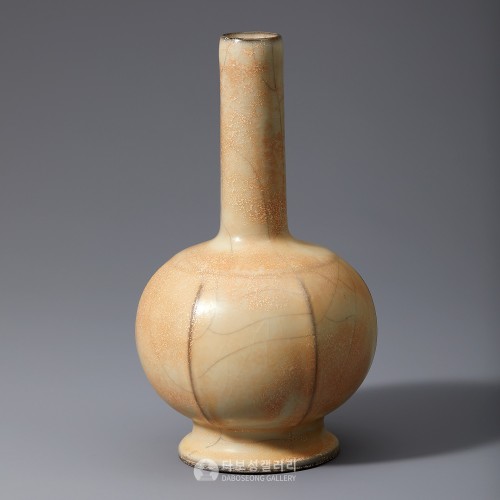
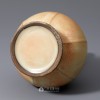
좁은 구연부와 길고 곧게 뻗은 목, 둥글고 풍만한 형태의 몸체, 아래로 갈수록 벌어지는 굽을 갖추었습니다. 몸체에는 6개의 능선이 있습니다.
미황(米黃)색 유약이 두텁게 시유되었으며, 표면에 갈색의 개편이 있습니다. 구연과 굽의 가장자리는 회흑색과 철갈색을 띠는데, 이를 자구철족(紫口鐵足)이라고 합니다. 태토에 철분 함량이 높아 생기는 현상으로, 유약이 흘러내려 얇게 시유된 구연부에는 환원 과정이 약하게 진행되어 회흑색 또는 자흑색이 나타나 자구(紫口)라 불리고, 유약이 시유되지 않은 굽 부분은 환원 과정이 더 강하게 진행되어 철갈(鐵褐)색이 나타나 철족(鐵足)이라고 불립니다.
자구철족, 미황 유색, 두터운 유약과 개편 등의 특징은 송대 관요 도자에서 확인되는 특징과 유사합니다. 관요(官窯)는 송대 5대 명요(여요·관요·가요·균요·정요) 중 하나로, 황실을 위한 도자를 제작하던 가마입니다. 송대 관요 도자는 태토의 철분 함량이 높아 환원 작용에 의해 자구와 철족 현상이 나타납니다. 도자의 질감뿐만 아니라 유색의 아름다움도 중시하여 천청, 분청, 미황, 유회색 등 다양한 색이 있으며, 보통 유약이 두껍고 표면에 개편이 있습니다. 이러한 점을 고려할 때, 이 유물은 송대 관요에서 제작된 것으로 추정됩니다.
器物口沿较窄,长直颈,器身圆润丰盈,底足外撇。器身饰有六道棱线。
通体施米黄色釉,釉层厚重,釉面可见褐色开片。口沿与圈足边缘呈灰黑色及铁褐色,这种现象称为“紫口铁足”。这是由于胎土中铁含量较高所形成的现象。釉在流淌过程中,口沿处釉层较薄,还原作用较弱,因此呈现灰黑色或紫黑色,故称“紫口”;而底足露胎,还原作用较强,呈现铁褐色,故称“铁足”。
紫口铁足、米黄色釉色、厚釉及开片等特征,与宋代官窑瓷器特点相近。官窑是宋代五大名窑(汝窑、官窑、哥窑、钧窑、定窑)之一,是专为皇室烧造瓷器的窑场。宋代官窑瓷器因胎土中铁含量较高,在还原作用下形成紫口铁足现象。官窑不仅重视质地,且更追求瓷器的釉色之美,釉色丰富,有天青、粉青、米黄、油灰等多种色调,釉层普遍肥厚,釉面多有开片。综合以上特征来看,此件器物推测为宋代官窑烧制。
The bottle has a narrow mouth, a long, straight neck, a rounded and full-bodied form, and a foot that flares outward toward the bottom. Six ridges run vertically along the body.
It is covered with a thick layer of beige glaze, with brown crackle patterns visible on the surface. The rim and edge of the foot are grayish-black and iron-brown, a characteristic known as purple rim and iron foot. This phenomenon results from the high iron content of the clay body. At the rim, where the glaze is thin due to its flow, reduction is less pronounced, producing a grayish-black or purplish-black color known as the purple rim. At the unglazed foot, stronger reduction produces an iron-brown color, known as the iron foot.
The characteristics of the purple rim and iron foot, beige glaze, thick glaze layer, and crackle patterns are similar to those found in ceramics associated with the Song-dynasty Guan kilns. The Guan kiln was one of the Five Great Kilns of the Song dynasty (Ru, Guan, Ge, Jun, and Ding) and produced ceramics for the imperial court. Song-dynasty Guan wares are characterized by the purple-rim and iron-foot effect resulting from the high iron content of the clay body and the reduction firing process. They placed importance not only on the texture of the ceramic body but also on the beauty of the glaze, producing a range of colors including sky blue, pale blue, beige, and grayish green. The glaze was generally thick and often featured crackle patterns. Considering these characteristics, this vessel is presumed to have been produced at a Guan kiln during the Song dynasty.