본문
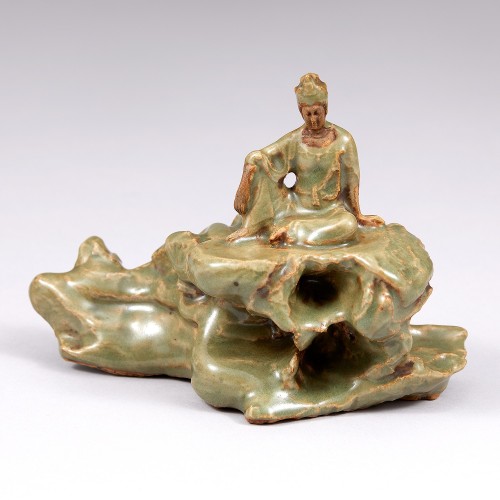
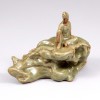
관음보살이 괴석 위에 앉아 있는 형상의 원 용천요(龍泉窯) 도자입니다. 머리에는 작은 화불(化佛)이 표현된 보관(寶冠)을 쓰고 있습니다. 고개를 약간 숙이고 시선은 아래를 향하고 있습니다. 오른쪽 무릎을 세우고 그 위에 오른팔을 올려놓은 자세이며, 왼손은 뒤로 바닥을 짚고 있습니다. 이러한 자세는 전륜성왕(轉輪聖王)의 좌법에서 유래한 윤왕좌(輪王坐)로 알려져 있습니다. 의문과 영락은 미세한 양각으로 표현되어 있습니다.
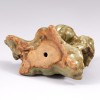
괴석 중에서도 태호석(太湖石)을 표현한 것으로 보입니다. 태호석은 중국 태호 지역에서 채취되는 구멍이 많고 복잡한 형태의 기석입니다. 문인들이 감상하던 대상이자 자연에 대한 관조를 반영한 요소로 사용되었습니다. 속이 비어 있는 투각 구조로 제작되었으며, 바닥의 둥근 구멍은 균열을 방지하기 위한 것으로 보입니다.
전면에는 청유가 시유되어 있으며, 유약층이 두터워 묵직하고 견고한 질감이 확인됩니다. 황색기가 도는 녹색 계열의 발색과 부드러운 윤기가 나타납니다. 관음보살의 얼굴과 손 부분에는 유약을 입히지 않아 태토가 드러나 있습니다. 표면에 유약이 얇게 시유되어 태토가 드러나는 부분은 짙은 유약면과 대비를 이룹니다. 이러한 노태(露胎)는 용천요 청자에서 확인되는 특징 중 하나입니다.
원대에는 용천요 청자의 생산량이 크게 증가하였으며, 인물형 도자 역시 활발하게 제작되었습니다. 관음보살상은 비교적 많이 제작된 유형에 해당하나, 현재까지 온전한 상태로 남아 있는 예는 많지 않아 주목되는 유물입니다.
━━━━━
此观音菩萨像烧制于元代龙泉窑,人物坐于怪石之上。头戴宝冠,冠上饰有小型化佛。微微低头,目光向下。姿态为右膝竖起,右臂置于其上,左手向后撑地。此类姿势被称为“轮王坐”,源自转轮圣王的坐法。以浅浮雕技法细致描绘衣纹与璎珞。
所依之怪石应为太湖石。太湖石产于中国太湖地区,具有多孔洞、形态复杂的特征,是文人赏石的重要对象,亦体现了对自然的观照。该器以中空透雕结构制作,底部设有圆孔,推测是为防止开裂所设。
器物通体施以青釉,釉层厚重,质感沉稳坚实。呈现带有黄色调的绿色釉,并具有柔和的光泽。观音面部与手部未施釉,露出胎体。釉层较薄而露胎之处,与厚釉部分形成对比,这种“露胎”是龙泉窑青瓷的典型特征之一。
元代时期,龙泉窑青瓷产量大幅增加,人物造像亦得到广泛制作。观音菩萨像属于较为常见的类型,但保存至今且状态完整的实例较为少见,是一件值得关注的作品。
━━━━━
This is a Yuan-dynasty Longquan ware ceramic figure depicting Avalokiteshvara seated on a scholar’s rock. The figure wears a crown adorned with a small transformed Buddha. The head is slightly inclined, with the gaze directed downward. The right knee is raised with the right arm resting on it, while the left hand is placed behind on the ground. This posture is known as the “royal ease pose,” derived from the seated posture of a cakravartin. The drapery and ornaments are rendered in fine low relief.
The rock appears to represent a Taihu stone, characterized by its perforated and irregular form. Taihu stones were appreciated by literati and were used as elements reflecting contemplation of nature. The structure is openwork, with the interior hollowed out, and a circular hole at the base is considered to have been made to prevent cracking.
A celadon glaze is applied overall. The glaze layer is thick, giving a dense and solid texture. It shows a green tone with a yellowish tint and a soft luster. The face and hands of the figure are left unglazed, exposing the clay body. Areas where the glaze is thin and the body is revealed contrast with the darker, thicker glazed surfaces. This exposed body is one of the characteristics observed in Longquan celadon.
During the Yuan dynasty, the production of Longquan celadon increased significantly, and figural ceramics were also actively produced. Although Avalokiteshvara figures were relatively common, examples that survive in complete condition are not numerous, making this a noteworthy piece.